Wednesday, 22 February 2012

FLOWER ARRANGEMENT (2ND YEAR) A.O.


Flower Arrangements in Interior Design


Flower arrangement is a design of beauty.  It is essentially a decorative piece and should be the centre of attraction. An arrangement can be composed of only flowers and or foliage or in combination with vegetables and fruits.  Flower arrangements have an ability to introduce a personal touch in an otherwise staid and impersonal hotel room.  Arrangements can be used in lobbies, restaurants, suites etc.  Guests appreciate flowers for the freshness they bring to the surroundings.  Arrangements need not be reserved only for parties or special occasions.  They can be used regularly depending upon the season and the theme. Unconventional and dry material can also be used to make arrangements which are more economical and last longer.

PRINCIPLES OF FLOWER ARRANGEMENT

The principles of design are applicable to flower arrangement as well.  Design determines the structural pattern of the arrangement.  It consists of the relationship between the flowers, foliage and containers.  Any design can be produced i.e. suitable to the occasion and the surroundings.  Design is determined by site of placement, function and materials available.  Arrangements may have also to be two sided or all round.

Balance:
Materials should be placed to give a feeling of stability.  Form and colour are important aspects of balance.

a.    Formal balance or Symmetrical Balance:
In this type, both sides have equal material on either side of the central line.  The flowers should have equal visual weight and colour.

b.    Informal or Asymmetrical Balance
In this, two sides are not equal but still have equal visual weight.  Dark colours give an effect of more weight than light colours.  They should be centred low in the arrangement.  Lighter colours give an impression of lightness and are more suitable towards the outer and upper ends of arrangement.

Scale:
It means proportion and relationship of the various parts of the composition.  The plant material has to be in proportion with the container used and the sealing of the plant items with each other must be kept in mind along with the site and function.  A flower arrangement is of good proportion when it is of right side for the container and placement.

Rhythm:
Rhythm can be described as a sense of movement, which flows through the main lines of the arrangement.  The purpose of it is to direct once eyes along it so that the shape of the entire composition is followed and understood.  In flower arrangement this is achieved by grading flowers and arranging foliage, leaning towards the sides.  These lines partly decide the design of arrangement.

Focal Point:
It is the central point of arrangement where emphasis is obtained by large accented flowers, group of flowers or use of darker colours.

Harmony and Unity:
Ensure that the materials are suitable for the site and the occasion.  The colours of the flowers and the container should blend with each other easily or provide a pleasing contrast with each other and with the background.  Unity of materials is necessary to view the arrangement without any distraction from the main line of movement.


BASIC PATTERNS OF FLOWER ARRANGEMENT:

The most basic patterns for flower arrangements are:

Vertical; Horizontal; Triangular; Rectangular; Circular; Curved; Asymmetrical
   
All the patterns have their base according to the surroundings.  Tall vertical arrangements are suitable for lounge areas while horizontal arrangements will be suitable on coffee tables, banquet tables and other low tables.  A circular arrangement is necessary on a coffee table and banquet table since it can be viewed from all sides. The pattern of the arrangement should not interfere with the purpose of the furniture arrangement.


EQUIPMENT FOR FLOWER ARRANGEMENT:
Like any craft, flower arrangement requires good equipments and proper tools.

1.    Vases or Containers:
These are of different sizes and colour.  They may be made of metal, glass, porcelain, wood etc.

2.    Flower Shears:
They may be of ordinary scissors type or with a spring for easy cutting of wooden stems.

3.    Pin holders:
These are made of heavy metal like iron with fine prospecting pins.  They may be of different shapes and sizes for use in different containers.

4.    Wire Mesh:
This is made of steel wire for supporting and balancing of flowers.


OTHER EQUIPMENTS:
Florists tape, foam, water spray, rubber bands, tooth picks, thin wire, rocks, pebbles, accessories like birds, butter flies, figurines, sheds etc. A sink, running water and working surface with storage area must be provided.

ESSENTIALS IN FLOWER ARRANGEMENT

1.         A good design                                     4.         Flower composition
2.         Right shape                                         5.         Accessories in the arrangement
3.         Colour of the container

While starting the arrangement, make a definite mental plan.  Design on the basic form in such a way that taller and wider material goes first in a definite leading line.  Locate the focal point low and near the centre.  Let the plant material partially cover the container.  Avoid even number of flowers except in a formal arrangement.  Keep the height of flowers 1/2 times the width of container. Place tall arrangements in tall containers but low containers can be used for both kinds of arrangements. Two items must never appear at the same height. Stems can be bent to obtain curves in the arrangement.  Avoid crossing of stems and observe the reflection of the arrangement in a mirror.


FLOWER ARRANGEMENT IN DIFFERENT LOCATIONS

Flowers are used for decorating various areas in the hotel like restaurants, reception area, lobby area, rooms etc.  They provide a cheerful appearance and colour to the room.  The arrangement should blend with the décor of the room.  It should be suited to the occasion and location.

Arrangements for VIP Rooms:
Arrangements here offer a great variety in design and imagination.  The placement will vary according to the type of room and its décor. The writing table, bedside table or coffee table should be used for placing tall arrangements.  The flowers used in rooms should not attract insects.

Flower arrangements for reception area:
The reception desk is the first area that the guest comes in contact with.  This desk becomes part of the lounge or lobby.  Arrangements should lend character and cheerfulness to the surroundings.  They should blend with the décor. Roses, tuberoses and gladioli, chrysanthemums, carnations etc are most suitable.  The arrangement may be two-dimensional since it needs to be viewed by the guest.

Buffet Table:
Flower arrangements on buffet table act as centrepieces and focus of attention.  The basic rules of arrangements in dining area should be followed and a multi- tier arrangement of a combination with fruits and carved vegetables can be made.  Flowers used should not have a strong smell.  Theme arrangements can be made in theme restaurants.

Banquet Table:
A banquet is a formal sit down service and the flower arrangement must also follow a formal pattern.  The colour should blend harmoniously with the décor of the banquet hall.  A table that is large with a seating capacity of 15-20 guests, should have at least 4-5 small arrangements.  These should be low and all round.  Flower arrangement for special banquets like wedding banquets or in honour of VIP guests should be formal and usually monochromatic.

Coffee Table:
For a coffee table a low mass arrangement that can be viewed from all sides is suitable.  Few large flowers combined with tiny blossoms are appropriate.  Arrangements can be informal and relaxing.


USE OF DRY MATERIAL IN FLOWER ARRANGEMENT

A dry flower arrangement is a long lasting arrangement that is made by using dried flower material.  Most dry material can be collected in autumn.  Examples of the materials for such arrangements are stems of barley, oats, rice etc. Pine cones, wood roses, bull roses, onion seed heads, poppy seed heads, corn cobs, lichen, wired shaped roots, dried grass, feathers, sea weed, dried lotus, Cyprus palm etc.   This material can be treated with a coat of varnish, paint or silver and gold wash.  Accessories like marbles, coloured glass, bits of metals or strips of metal foil, dried berries, feathers, pebbles, drift wood, ribbons, thremocoal balls, candles, bells, glass balls can be used.


FLOOR SURFACES (3RD YEAR) A.O.


Floor Surfaces


Floor surfaces cover a large area of the room and are subjected to constant wear. They are expensive and replace less frequently than other furnishings. Improperly laid floors or damaged floors can cause accidents and damage to the equipment.  Floor surfaces must be comfortable and quiet besides contributing to the décor of the room.  The traffic in the area and utility of the room must also be considered.

FACTORS FOR DETERMINING FLOOR SURFACES:

Appearance:
Colour, pattern and texture of the floor surfaces should be compatible to the size, décor and activity of the room. Pale colours provide a cool appearance of warmth. Patterned surfaces add interest to the room.

Comfort:
Foot fatigue should be reduced by use of soft resilient surfaces.  Floor surfaces should not be noisy or slippery.

Durability:
Grit, dragging of furniture and placement of equipment or circulation of heavy traffic should not damage the floor surface.  They should also not be affected by the cleaning reagents and food spillages.

Life Expectancy:
Since floor surfaces are not changed frequently, they are expected to last for longer time.

Safety:
Safety to the guests and occupants must be considered.  Fire resistance, slip resistance and accident proof surfaces must be selected.

Ease of Cleaning:
Ease of maintenance and cleaning costs must be considered while selecting them.

Cost:
The cost of floor surface, cost of laying and maintenance should be considered before selection.

Types of Floors:
Floor surfaces are divided into two types hard and soft floors.  A sub floor is laid below the floor surface, which may be made of soft wood or hard board.  It should be free from dampness, dirt and unevenness.  This protects the top floor.


HARD FLOOR SURFACES

Stone Floor Surfaces:
These are commonly used in areas that must withstand heavy traffic, repeated washing and movement of goods. These floors are extremely durable and hygienic.

Concrete:
It is composed of cement and sand. Pigments may be added to provide colour.  This floor can withstand large weights but is damaged by acids and alkalis. It is suitable for stores, sub-floors, laundry, staircase etc. Concrete is extremely porous, hard and soiled easily.  A scaler may be applied to make it stain resistant.  These floors are suitable in halls, lounges, corridors, and bathrooms and as tabletops.

Wooden Floor Surfaces:
These floors are used in all types of establishments for corridors, dance floors, bar areas, dining halls, game rooms etc.  They are more attractive than stone but are very porous and easily damaged by moisture and pests.  A ceiling polish must be applied to increase durability. Strips of wood are cut into varying lengths and laid on a sub floor.  The colour of the floor will depend upon the type of wood used.  Oak and teak are the common types of wood used for flooring. Designs can be created by varying the colour of wooden tiles (blocks) and arranging them in different patterns.

Cork Tiles:
Cork is obtained from the bark of the cork of oak tree.  It is the least resistant of hard floor surface.  It is a good insulator, warm, resilient and quite easy to maintain.  It has high degree of slip resistance but the tiles cannot withstand heavy furniture, grease, and moisture and alkalis.  The colour of natural cork is brown and pigments may be added to obtain other colours e.g. Green.

Resilient Floor Surfaces:
These floor surfaces include certain plastics or finishes which make them moisture and grease resilient. 

Terrazzo:
This consists of marble chips, set in cement.  It may be plain or coloured and ground smooth.  This is not used in small areas but preferred around pools and in gardens.  These floors are porous and damaged by acids, alkalis and grease.  They are unharmed by water and have good slip resistance when polished.  The common colours are white, green, blue and black.

Ceramic Tiles:
Ceramic tiles are made of clay and fired at high temperature.  They are hand or machine made, glazed and unglazed. Shapes of the tiles may be square, rectangular or hexagonal. Tiles are waterproof and impervious to cleaning liquid.  They are commonly used in bathrooms, kitchens, laundry, canteens, bars etc. These floors are hard, noisy and tire the feet.  Ceramic floors should not be polished since that would make it dangerously slippery.

Mosaic:
They are made of glass, silica and clay.  They may be set directly on the floor or made as tiles and laid on a sub floor unaffected by pests or fungi and the glass can be retained for a long time.

Timber:
Well-maintained timber floor surfaces provide attractive hygienic, warm and serviceable floors for a long time.  They may be laid as strips, boards or blocks.  Floorboards are made from soft woods while strips are constructed from hard woods.  The colour of the floor depends upon the natural grain.  A sealer may be applied or a polish given to the wooden floor to make it glossy and dirt resistant.

Chip Board:
Chipboard is obtained by mixing wood chippings or sawdust with resin or cement at high temperature and pressure.  Unlike timber it does not warm or split.

Linoleum:
This is made up of lignum, i.e. flax and ileum in oil. Ground corkwood, linseed oil and resins (gum) are pressed on to jute backing.  This is prepared in sheet or tile form.  Plain colours marbling or patterns may be applied for decorative effect. Linoleum may crack if laid on poor quality sub floor. It is hard wearing, resilient and warm, but may peel, rot and gets destroyed by alkalis.  It is non-flammable but burn marks can be seen.  This is suitable in the linen room, store pantry, kitchen stores.

Rubber:
Rubber floors are usually made by a combination of natural and synthetic rubber.  They may be laid in sheets or tile form.  They may be coloured and mottled with inlaid patterns.  The floor is hard wearing, resilient, quiet and waterproof.  It is non-slip and may be grease resistant.  Damage may occur due to alkalis, acids and spirits.  They are not affected by mould, bacteria and pest infestation.  It is commonly used in kitchens, bathrooms, health clubs, near swimming pools etc.

Thermoplastic Floors:
These are made of asphalt, fibres, mineral fillers and pigments or synthetic resins with vinyl binder.  The tiles are usually dark coloured and quite durable.  They have good thermal insulation and are resistant to water.  They are damaged by heat, acids and alkalis.  They are useful in canteens, corridors, shops and offices. PVC may be added to make hard thermoplastic more flexible.


Vinyl:
Vinyl is made from asbestos, fibres, mineral pigments and PVC.  They are very hygienic and deal in hospitals, kitchens, dining area, nurseries, common rooms, lifts etc. They are water and oil resistant and can be made slip resistant.  They are damaged by cleaning gels, high temperature and acids.


FLOOR COVERINGS
Floor coverings or soft floors are used for variety in colour, texture and design.  They are warm, durable, quiet, slip resistant and economical.  Various types of colourings may be used in different areas depending upon cost of maintenance, cost of installation, attractiveness and use.  Soft floor coverings commonly consist of two types: Carpets and Rugs.

Carpets:
Carpets are used extensively in hotels and institutional establishment.  The type of carpet selected will depend upon the suitability and traffic in the area.  They may be used in bedrooms, lounges, TV rooms, restaurants, office and corridors.  A good quality carpet should be able to withstand spillages, cigarette ash and grit.  They must also be resilient to heavy furniture.

Carpet Construction:
Carpets consist of three layers: a pile, a background and an underlay.  The pile is held into the backing with knots and adhesives.  The underlay acts as a shock absorber between the backing and the sub floor.  It makes the carpet softer and provides insulation.  Underlay may be made of felt, rubber, foam or jute with polypropylene backing.

Backing:
Natural materials like jute, hemp, glue and starch are used along with resin, synthetic rubber and polypropylene to form the backing.  A secondary backing may be added to improve resilience.

Pile:
The carpet pile absorbs most of the wear.  It should be strong and resilient, shrink- proof, moth proof and flameproof.  The carpet pile is frequently made of blends of fibres.

Wool:
Woollen carpets are warm, soft, resilient and do not attract dirt.  However, they are difficult to maintain and quite expensive. They may be blended with 20% nylon.

Acrylic:                   
This is close to wool in appearance, wears well, is warm and resilient but soils easily.  This is not easy to clean and not fire resistant.

Polyester:
This is often blended with nylon.  This is waterproof, easy to clean, soft and hard wearing.

Viscose Rayon:
This is inexpensive and not hard wearing and is sometimes used in blended carpets along with nylon.


TYPES OF PILING:

Cut Pile:
In these types of carpets, the ends are cut on the surface of the carpet. The pile may be short and smooth or long and shaggy.  It may also be cut long and short.

Looped Pile:
It is uncut and may be tufted.  It could be shaggy or smooth.

Cut and Looped Pile:
This is a combination pile used in pattern carpets.

TYPES OF CARPET CONSTRUCTION:

Woven Carpets:
Here, the pile and backing is produced simultaneously.  The pile is secured with a knot and is therefore very strong.  The pile may be either cut or uncut.  This type of weave gives a sculptured effect E.g. Axminster carpets, Wilton carpets.

Pattern Carpets:
These are woven on the jacquard looms which draw up one thread at a time to form the pile while the remainder stay hidden in the backing giving strength, warmth and resilience.  Up to five colours may be used in the carpet construction. E.g. Wilton and Brussels.

Woven carpets are expensive but very durable and are used in hotel reception areas, corridors, dining area, bedrooms, lounges etc.

Tufted Carpets:
These are cheaper than woven carpets and forms 50% of the carpets produced.  These are made by inserting tufts into a backing and securing with latex. The pile is looped, cut or combination.  The carpet manufactured by this technique is very fast and comes in various dimensions.  They are commonly used in hotels and institutions.  Care is necessary to prevent over wetting which may damage the adhesive.

Needle Loom:
These carpets have no pile but are made by needle punching and entangling a mixture of fibres through a backing fabric and coating it with resin.  Nylon, jute and polypropylene are used.  Heat may be applied to fix the fibres.


Bonded Pile:
In this type of carpet, the pile is compacted and bonded to an adhesive backing.  Shortcut pile, loops, cords or electrostatic flocking may be used.  Application of heat causes firm bonding.

Hand Made Carpets:
These are traditional carpets, backed by centuries of excellence in manufacture.  They are functional as well as aesthetic.  They have a long life, durability and richness of weave and design.  They are made by knotting pieces of yarn on to a backing weave.

Carpet tiles and carpet felt may be fixed to areas where low cost carpeting is necessary.

LAYING OF CARPETS
Carpets in hotels and institutions are fitted from wall to wall and along the skirting.  The carpets may be fixed by using glue or narrow strips of wood, which are tacked to the wall, or sunken into a recessed area in the floor carpets along staircases must be fixed permanently with metal tacks to prevent accidents.  Special treatments like flame proofing, moth proofing, water resistance and anti static treatment may be given to carpets to improve their function of durability and ease of maintenance.  Disinfectant solutions may be also added in carpet treatment.

CARE AND MAINTENANCE

Carpets are easily soiled and damaged. They require regular and frequent care.  Daily attention must be provided to remove stains and dirt from carpets.  Dust, dirt, grit, organic substances and cigarette ash may cause damage.  Furniture indentation and cigarette ash, residue shampoo and pests may damage the pile.  Spot cleaning of stains immediately is essential to prevent penetration and built up stains.  Dry suction, vacuum cleaning must be done everyday to remove surface dust and grit.  Scraps of paper, pins and other wastes must be brushed away before vacuuming.  Shampooing of carpets is essential periodically.  The frequency depends upon the type of traffic and nature of carpets.   Most housekeeping departments may call for contract cleaning.  Carpets must be tested before shampooing.  Hand shampooing is very tiresome and ineffective.  It is suitable for corners and stairs.  Liquid or dry foam shampoo may be used.  This traps the dirt and loosens it from the pile.  Special brushes help to clean from the pile.  Special brushes helps to clean the pile.  Spot cleaning of stains using apt reagents may be necessary before shampooing.  Use diluted agents to prevent damage.  Freshly spilt liquids can be absorbed or squirted with a soda siphon. 

RUGS AND MATTINGS:
Rugs may be used on floors where wall-to-wall carpeting is not advisable. In heavy traffic areas, rugs can be turned over to neutralize wear and tear.  They can be rolled and removed for cleaning and modifications in arrangement.  Rugs may be used to control noise and add colour or pattern to the floor.  They are made of cotton, wool or blended with synthetic material. Special rugs may be constructed according to the requirement.  Finishing around the rugs is essential to prevent accidents.  Turned up covers must be avoided.

Matting is used in corridors, building entrances around swimming pools and outdoors to prevent heavy soiling and provide noise control in the area coir, cotton and filtered fibres are most common.


FABRICS AND SOFT FURNISHINGS (3RD YEAR) A.O.


Fabrics and Soft Furnishings


For thousands of years, fabrics have been used in furnishing to provide warmth, comfort, protection and decoration.  They have been used as draperies, padding, hangings and coverings to provide comfort and protection.  Fabrics are used a great deal in interiors according to style, theme and décor.  Loose draperies and hangings were common features in medieval Europe.  The richness of the interiors was concentrated in textiles.  These were embroidered, dyed, painted to dramatically alter the appearance of a bare room.

TAPESTRY

Tapestry is often confused with a cross-stitch pattern used in wall hangings.  Originally, tapestry referred to pieces of fabric hung on the wall.  Different sets of tapestry were hung according to the time of the year. In autumn and winter, hunting and hawking scenes were popular, pastoral and romantic ones were associated with spring and summer.  War scenes from crusades and Trojan legends provided decorative themes.  Most of the techniques are as old as the 17th century.

UPHOLSTERY

Upholstery with fabrics and its techniques had been mastered by the end of the 17th century, by borrowing splendid material and lavish trimmings.  Initially these were detachable loose covers, which were later converted to fixed upholstery. These wrappings were supposed to be removed when the furniture was used.  Tapestries, furniture and carpets beside silk damasks and velvets were mostly produced in France and Italy.

MATERIALS USED FOR UPHOLSTERY

Textiles:
Textiles of different fibres, yarns and weaves are used for upholstery.  The selection depends upon the purpose of comfort, décor and ease of maintenance.  Various finishes are provided to enhance its performance. Textural variations can also be obtained through use of textiles.  Smooth fabrics like brocade, damask, wool etc. were used.

Types of Textiles

Wool:
Wool is an ideal fibre that is soft, comfortable and dyes well.  It is also flame proof.  Wool jacquard and wool piles are suitable upholstery material.  Knots and loops can be added to provide interest to the surface.

Silk:
Silk is a luxury fabric and impractical.  It is found in antique chairs and for the construction of velvet and brocades.


Cotton:
Cotton is used extensively for upholstery particularly for loose covers.  Cotton fabrics are easy to print and dye with low prices.  Heavily dressed cotton should be avoided. Cotton pile like corduroy and velveteen are suitable for upholstery since they are pleasant, comfortable and durable.

Linen:
Linen fibres are firmer more lustrous and stronger than cotton ones.  However, they crease easily.  They can be suitably blended with cotton.

Rayon:
Rayon is a synthetic fibre sometimes used as a blend with natural fibres.  It is cheap and durable with good abrasion resistance. Rayon velvets and rayon brocades are used as silk substitutes.

Nylon:
Nylon is extensively used for stretch covers.  The fibre is knitted and provides greater elasticity.  This may be blended with wool. Nylon fibres are quite tough and abrasion resistant.

Acrylic:
Acrylic resembles wool in its properties. Dralon acrylic is suitable for velvets.  Acrylics are tough, washable and long lasting. They are colour fast and easy to maintain.

Moulded Fabrics:
They are synthetic material that is produced as continuous sheets instead of fibres.  They may be used for loose covers and fixed upholstery. 

Blended Fabrics:
Natural and synthetic fibres may be combined to create blends with good qualities and low price.  Woollen blends are made with wool and rayon or acrylic.  They have greater resilience, durability and are less expensive.  Cotton and linen blends are quite common and ideal for loose covers. Terrene, rayon and nylon may be blended to provide better abrasion resistance.

COMMONLY AVAILABLE UPHOLSTERY FABRICS

Brocade: A multi coloured jacquard pattern cotton, silk, wool or nylon.

Brocatelle: Heavy fabric with raised patterns formed by satin weave on plain background.

Chintz: Patterned cotton fabric with glazed finish.
              
Corduroy: Weft pile fabric made from cotton or velvet in the form of chords.

Cretonne: Printed cotton or rayon in plain or twill weaves heavier than chintz.

Damask: Self-coloured, satiny fabric with traditional woven floral designs in cotton, linen, silk or synthetic fibres.
Denim: Twill weaves cotton fabric.

Gabardine: Lightweight, closely woven cotton fabric.

Lace: Hand or machine made cotton or nylon open work fabric with designs

Net: Transparent fabric made of cotton or synthetic yarns.

Satin: Soft cotton fabric with a surface sheen.

Seersucker: Crinkled cotton or nylon

Taffeta: Crisp, plain weave fabric with a distinct sheen made of synthetic fibres.

Tweed: Heavy coarsely woven woollen fabric

Twill: Is a diagonal weave cotton fabric.

Velvet: Pile fabric made from cotton as man made fibres that are very expensive.

Voile: A lightweight fine fabric made from cotton.

HIDES:

Leather is the most unbeatable fabric for upholstery.  It is tough, wears well and looks good even after prolonged use. Untreated natural leather may be used for outdoor furniture upholstery. Suede is more expensive than plain leather and requires great care.  It is soft and requires special treatment to make it long lasting.

The natural colour of leather like brown may be retained or it may be dyed in blue, green, pink, black etc.

Synthetic leathers are made of PVC and known as foam leather.  This is simulated leather which can be obtained in various textures and patterns.  This leather is therefore cool in summer and warm in winters.  Several designs can be constructed from the material.

Important Factors to Consider for Upholstery Selection:

  • Resistance to abrasion
  • Resistance to fading and colour fastness
  • Crease Resistance
  • Resistant to pests
  • Resilience
  • Ease of cleaning
  • Wear and tear resistance

CARE AND MAINTENANCE:

Upholstery should be protected from pests and pets.  Dogs and cats may damage them by their claws and shredded hair. Perching on the arms may cause damage to arm covers. Cigarette smoke is absorbed by upholstery.  Sunlight causes fading and discolouration while heat may cause warping of wood. Condensation may cause moisture absorption of fabrics.

Remove stains by spotting as soon as they occur and protect chair backs and arm rests with loose covers.  Observe for woodworms, which may also damage the fabric.  Remove seat cushions for even wear. Wash or dry-clean removable covers and shampoo fixed covers with dry foam periodically. Leather upholstery should be dusted regularly and brushed.  Cream polish may be applied.  A cloth soaked in warm water with detergent may be used to wipe lightly when excessively soiled. Dry thoroughly and polish.  Plastic covered upholstery should be dusted regularly, vacuumed and wiped with moist cloth.

SOFT FURNISHINGS


Soft furnishings include fibres that are used for curtains, loose covers, cushions, bedspreads and quilts.  They contribute greatly to the appearance of the room by bringing to it colour, pattern and texture.  Some articles in addition provide warmth and comfort. Each article is subjected to variable amount of wear and tear.

CURTAINS

Windows dressing is essential to enhance or obscure the shape of the window and improve the style and décor of the window and room.  It provides privacy and thermal insulation, controls light, and helps in sound reduction.  This can be achieved by the use of curtains. The line, colour, pattern and texture contribute to character and atmosphere of the room.  Selection of fibre should be done with regard to its resistance to fading, abrasion, drape, dimensional stability and flame resistance.  The exposure to sunlight and airborne soiling should be considered. Lining of curtains helps to reduce damage of fading and rotting.  Curtains are subjected to abrasion by being pulled and drawn, brush against, rub along a floor or window frames and being laundered.  The abrasion resistance depends upon the type of fibre selected and fabric construction. Loosely woven material tends to loose drape and constant hand drawing may cause loss of shape.

Fibre for Curtains


Natural fibres like cotton, wool and linen have high tenacity and wear well. They do not catch fire fast and provide good thermal insulation.  Loosely woven fabrics do not drape well and these fibres may become yellow due to oxidation.  Synthetic fibres like nylon and polyester are easy to maintain and wear well.  They have good abrasion resistance but may be highly flammable.  A flame retardant finish is desirable.  Other fibres like glass fibre, acrylic and blends are also popular.  Plastic is used for shower curtains.

TYPES OF CURTAINS

Glass curtains:
These are made of sheer fabrics of simple straight-line covering the entire window area with draperies.


Back curtains:
These are made of sheer fabrics and lightweight material with decorative ruffles.  They are fixed on the frame or wall by special fixtures.

Criss cross curtains:
Wide panels are mounted on walls so that they overlap on the top and are tied back.

Café Curtains:
Short curtains that cover the portion of a window often hung on decorative rods by means of rings.

Cottage curtains:
These are combination of café and back curtains.

Tier curtains:
Two or more horizontal rows of short curtains, which are mounted on rods so that they overlap.

Vertical draw curtain:
These are mounted on traverse tracks so that they can be drawn open.

Vertical drop curtain:
These are curtains, which move up and down and are found in theatres and cinema halls.

Swag and Tail curtains:
These are heading at the top of the curtains and form an integral part of the styling.

Curtains are fixed to the track by rings or hook and drop to the floor or windowsill.  The fabric for the curtain should be a large piece hanging in folds with the entire pattern visible.  It is better to avoid fabrics with white background in large establishments.  The general width of the material may be 90 cms, 120 cms, 150 cms or more.  The curtain width should be a minimum of one and half times the track width.  Lining the curtain helps to protect from dirt or sunlight and provides good drape.  Silk fabrics are expensive and usually used in luxury establishments in public areas and suites. Brocades, damasks, velvet's and a variety of weaves may be used. For the bedroom, a lighter material like cotton, linen, chintz, satin etc may be used.  In bathrooms, a heavy window does not require curtains but nylon, plastic and glass fibre material are often used for shower curtains.  Plastics may easily dry but may tear easily.

GENERAL POINTS IN CURTAIN CONSTRUCTION

  1. Velvet and pile fabric should hang with the pile running downwards.

  1. 15-30 cms should be allowed for hem and turning on each curtain.

  1. For floor length curtains, it should be 1.5 - 2.5 cms. above floor level to prevent friction.

  1. The minimum width for any curtain should be one and half times or 2 times the width of the track.

  1. The curtain heading may be gathered, pleated or held with tapes.

  1. Lining should be fixed at the top and side of the curtain but not attached at the hem.

  1. Hems and sides should be hand sewn but not machine stitched.

  1. Heavy curtains may have weights or chains at the hem to improve the hang.

  1. Flame retardant fabrics should be used in public rooms.

  1. Draw cords or curtain controls should be used to pull the curtain.

Care and maintenance


  1. Keep the rod and track free from dust by using wall broom or vacuum cleaner.

  1. Shake the curtain to dislodge dust.

  1. Deal immediately with fade edges, stains, detached hooks and gummed curtains.

  1. Reverse double sided unlined curtains for fading.

  1. Use dry cleaning or solvent sprays for brocade, damask curtains.

Loose Curtains (Covers)/ Skirtings

These are detachable, fitted over, upholstered chairs, stools etc.  They give a clean, fresh appearance but require constant maintenance. They protect the original upholstery and can be changed more frequently.  Fixtures like holes, zips or Velcro can be used to hold them in place.  Closely woven fabrics like chintz, crystalline with close weave are preferred for these covers.  They can withstand abrasion and do not snag easily.  The pattern, colour and texture of material should blend with the décor and other soft furnishing.  Loose covers may be laundered but dry cleaning is preferable to avoid shortage.  Nylon stretch covers may be used. To protect upholstered furniture from soiling, arm and back covers may be used.

Care and maintenance

  1. Shake and tidy frequently
  2. Brush and suction clean regularly
  3. Dry clean as required

CUSHIONS

It may be used to increase the comfort of chairs and sofas and provide colour pattern and texture to the room.  They may be fitted to form a seat or a back; or may be used loosely as scatter cushions.  Shapes may vary from square, rectangular, circular, triangular, semi-circular to bolsters, which are elongated pillows. They will be filled with down, feathers, kappa, rubber, polyfill, urethane foam, thermo coal ball, silk cotton, foam plastic etc.

Care and maintenance

Cushions require constant attention
  1. Shake and tidy frequently
  2. Repair when necessary
  3. Brush and suction clean regularly
  4. Remove covers and wash or dry clean.

QUILTS

Provides a warm light bed covering but are quite expensive initially. They may be used as such or given a fabric covering.  Satin, polyester, silk and good quality fabrics are suitable for the top layer of the quilts.  Less slippery material like satin or linen may be used for under layer to prevent slipping.  They may be placed loosely on the bed or fixed with zips and flaps.  Duvets and eider downs are filled with down or synthetic fibres and used in place of blankets.  All the materials should be fire retardant.  Sheets of sponge can be used as an inlay.

Care and Maintenance

1.    Attend to repairs
2.    Check for stains and dirty marks
3.    Shade occasionally
4.    Launder and dry-clean when necessary


ELEMENTS AND PRINCIPLES OF DESIGN-( 3RD YEAR )


Elements Of Design


All visual designs are reduced to elements or dimensions.  The elements of art are the basic structure and comprise of line, form, colour, texture, pattern, light and space, which apply to the furnishings and room planning. The effect of these elements is reflected by our instinct and intellect.  They make a visual impact and evoke emotional response.

Following are the different elements of art and design:

Ø  LINE:
Directions of line such as vertical, horizontal, diagonal or curved express various ideas and themes. Straight vertical lines convey strength and force, while the horizontal lines suggest response, secrecy and relaxation.  Curved lines introduce a softening effect while spiral lines show activity and interest.  Lines can be used to introduce variety and design.

Ø  FORM:
Form and line are closely related wherein the combination of curve, straight or diagonal lines help to produce the three dimensions and create form and shade.  Form represents solid and tangible substances. Horizontal and vertical lines combine to create a rectangular or square form.  Curved lines create circular form. Form can be created within enclosed space by arranging substances.

Ø  COLOUR:
The main characteristics of colours are hue, value and intensity. Hue is the name of the specific colour; value which represents lightness or darkness; intensity the brightness or darkness of the colour.

Ø  TEXTURE:
The roughness or smoothness of a surface is referred to as texture.  Texture is found in wall finishes, carpets, furniture, paintings etc. The texture quality of any surface is controlled by touch.  It also makes a difference to the depth of colour, which results in brightness or darkness of a colour.  The coarser the texture, the lesser is the amount of light reflected and therefore the duller the colour.

Ø  PATTERN:
Colour is used frequently in connection with pattern.  This adds interest and variety to a decorated scheme.  Careful consideration is necessary before introducing pattern.  Too much of pattern disturbs the eye and creates restlessness in a room.  Pattern is introduced through floors, floor coverings, through walls, wall coverings, furniture, furnishings and fittings.

Ø  LIGHTS:
This is an art element which is both functional and decorative. It has a dispute, proportional and emotional effect.  Colour depends upon the light in which an object is viewed.  The quality of light is important for colour.  The utility of the room should be considered while planning lighting.  Natural and artificial lighting should be selected appropriately.  This may cause variation in the appearance of colours.

Ø  SPACE:
The importance of space as on art element is widely recognised.  Space organisation is a basic element in architecture and interior design.  Space creates beauty and is necessary for areas to be used effectively. Fluidity or flow in the room is important and the eye is encouraged to travel small spaces can be enlarged by using large glass windows.


PRINCIPLES OF DESIGN:
The elements of art are line, form, colour and texture.  This must be handled within conformity with certain principles and laws that govern their use if beauty is to result.  Every art field has certain guidelines that are to be followed and the same is applicable in planning of interiors.

1.    SCALE AND PROPORTION:
By habit, the human eye becomes accustomed to definite dimensions in daily life.  Some of these dimensions are fixed for convenience.  Proportion is the law of relationship, which demands that all space divisions should be pleasingly related to each other and to the whole. The Greeks developed a great deal of calculations about space distribution and a scale of space relationships. These skills are used even today.  The normal ratios are 2:3, 3:5 and 5:8.  These forms are equal divisions.  A square room is more difficult to arrange and uninteresting to live in.  Rooms should be preferably furnished with smaller furniture types and consistent patterns.  The furniture should be in proportion to the size and height of the room and its architectural features.

2.    BALANCE:
It is the principle of design, which produces a feeling of restfulness and contentment.  Balance deals with quantity or number in the arrangement, colour and distribution of pattern or plain surfaces.  Balance is the result of equalisation of attraction on either side of a central point.  Balance can be attributed to colours, texture, pattern and light. 

There are two types of balance:

Formal Balance and Informal Balance

Ø  Formal Balance:
Formal or symmetrical balance occurs when objects of equal size and weight are placed on each side and at equal distance from the centre.  When they are identical, the balance is symmetrical.

Ø  Informal Balance:
Informal or asymmetrical balance results when objects are arranged in such a way that a large one nears the centre, smaller ones away from the centre.  Both types of balances are attractive.  Formal represents intellect while informal represents feelings.  This also has emotional significances.

3.    RHYTHM:
This is the principle of design that suggests connected movement in a pleasant manner.  It can be obtained through a repetition of light, forms, and colours or through a progression of rise or continuous line movement.  Rhythm is achieved through repetition, progression, transition, opposition and radiation.


4.    EMPHASIS:
It is the principle of design that centres interest on the most important thing in the arrangement in a room. Emphasis may be centred on a painting, fireplace, window treatment or furniture grouping.  All other parts must be subordinated to the interesting point.  It is better to understand emphasised rather than over emphasized.  Emphasis can be created at any point in the room.  Dramatic use of art components creates emphasis i.e. large and unusual forms, different surface patterns, more light elsewhere and unusual texture and contrasting colours.

5.    HARMONY AND UNITY:
It is an expression of an agreeable combination of all the parts that are produced. In other words, if all other elements of design have been combined as per the principles, it inevitably results in unity. Unity and harmony demand that size, shape, textures, colours and ideas are pleasingly related e.g. a copper lamp would look charming in an ethnic arrangement but not in a modern formal one.


Wednesday, 8 February 2012


THE SYSTEMATIC LAYOUT PLANNING PATTERN
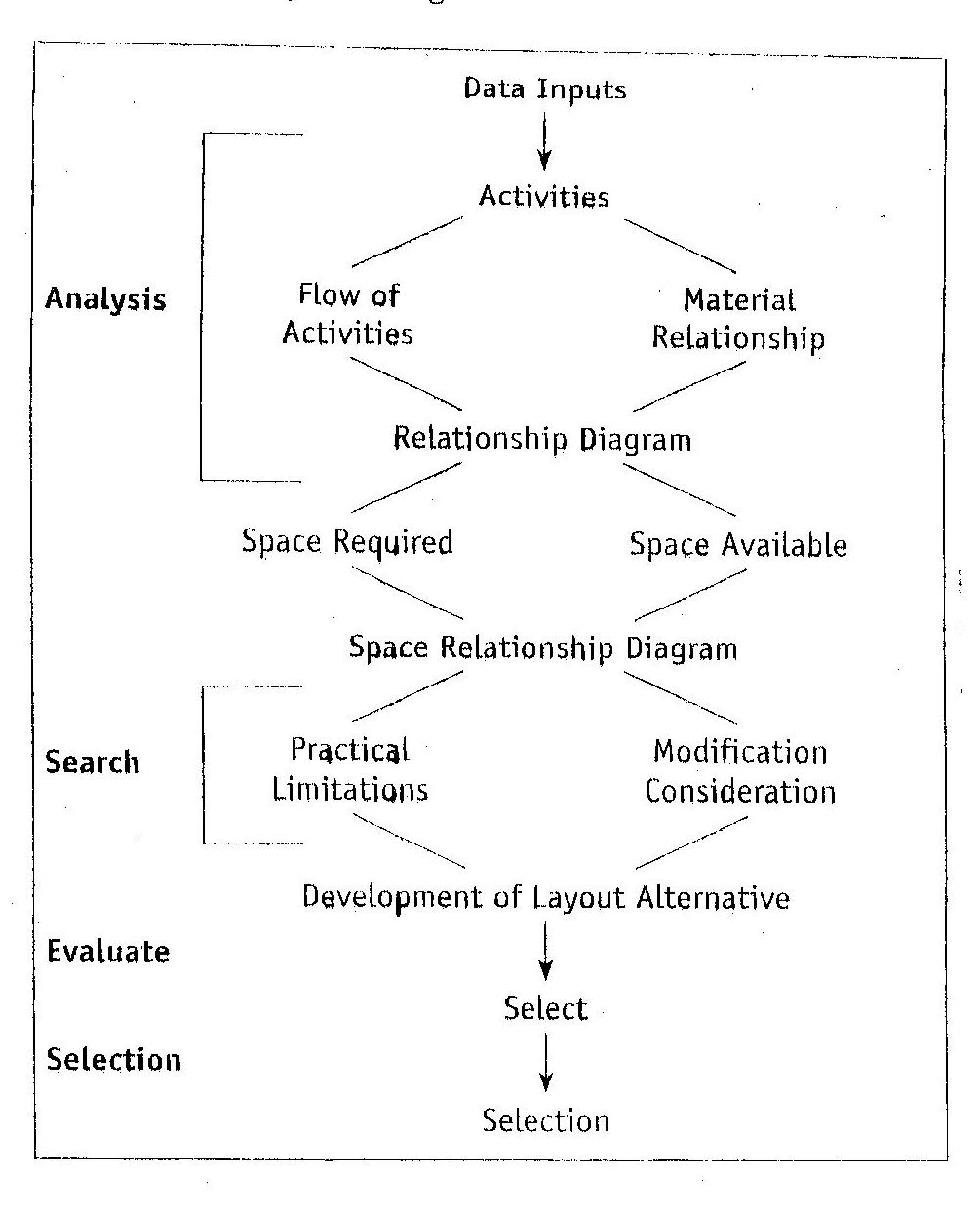
Systematic layout planning is an organized way to conduct layout planning, it consists of a framework of phases, a pattern of procedures and a set of conventions for identifying , rating and visualizing the elements and areas involved in a plan.


Each layout rests on three fundamentals
  •  RELATIONSHIPS - degree of closeness desired among things
  • SPACE - the amount, kind, shape of config of the things to be laid out
  • ADJUSTMENTS - arrangement of things into a realistic best fit
These are the heart of any layout plan regardless of products, processes or size of project.


Data input of the pattern is most significant
in a process and by planning the layout
around the sequence and intensity of
material movement we attain a
progressive flow thro the areas
involved.
In addition many supporting service
areas must be planned & integrated,
thus developing activity relationships.
These are combined into
Flow and / or Activity Relationship
diagram.
Here activities, departments or areas are
geographically related to each other
without consideration of actual space
required
Next the space requirements
are developed from process machinery
and equipment necessary or service
facilities involved
Area requirements must be balanced
against space available.
Then the area allowed for each activity is
hung on the activity relationship diagram
to form a Space Relationship Diagram.

This is essentially a layout but is not effective unless adjusted or manipulated to integrate with space and
modifying considerations hence we get various alternatives and each must be tested against practical
limitations like
•cost
•safety
•employee preference

Remember each alternative has to work the problem lies in which one to select at this point a cost analysis of some kind should be made for comparison and justification as a result one may be chosen although
frequently a modification or combination of two or more layouts may be chosen this completes phase II !

Tie in PQRST:

The product designs and sales forecasts must be woven together with PQ analysis also called as product mix or volume variety. A specific analysis of product mix, along with Routing, services and times
leads to demarcation of individual activities or workgroups hence a final layout

FLOW OF MATERIALS
Routing means how an item is made - its process this is established by operations and sequences that will best produce P & Q wanted in optimum T This yields the basic data for analyzing the flow of materials


Allan H Mogensen developed a simplification check which challenges each step in the process
routing as below
• ELIMINATE- is the operation Necessary or
can it be eliminated
•COMBINE - can the opeartion be combined
with some other action or
operation
•CHANGE SEQUENCE,
PLACE OT PERSON- Can these be changed or
rearranged ?
• IMPROVE DETAILS -can the method of operation
or equipment be improved


   FLOWER ARRANGEMENT  - DESIGN CONSIDERATIONS

  
Flower arrangement is a design of beauty.  It is essentially a decorative piece and should be the centre of attraction. An arrangement can be composed of only flowers and or foliage or in combination with vegetables and fruits.  Flower arrangements have an ability to introduce a personal touch in an otherwise staid and impersonal hotel room.  Arrangements can be used in lobbies, restaurants, suites etc.  Guests appreciate flowers for the freshness they bring to the surroundings.  Arrangements need not be reserved only for parties or special occasions.  They can be used regularly depending upon the season and the theme. Unconventional and dry material can also be used to make arrangements which are more economical and last longer.

PRINCIPLES OF FLOWER ARRANGEMENT

The principles of design are applicable to flower arrangement as well.  Design determines the structural pattern of the arrangement.  It consists of the relationship between the flowers, foliage and containers.  Any design can be produced i.e. suitable to the occasion and the surroundings.  Design is determined by site of placement, function and materials available.  Arrangements may have also to be two sided or all round.

Balance:
Materials should be placed to give a feeling of stability.  Form and colour are important aspects of balance.

a.     Formal balance or Symmetrical Balance:
In this type, both sides have equal material on either side of the central line.  The flowers should have equal visual weight and colour.

b.     Informal or Asymmetrical Balance
In this, two sides are not equal but still have equal visual weight.  Dark colours give an effect of more weight than light colours.  They should be centred low in the arrangement.  Lighter colours give an impression of lightness and are more suitable towards the outer and upper ends of arrangement.

Scale:
It means proportion and relationship of the various parts of the composition.  The plant material has to be in proportion with the container used and the sealing of the plant items with each other must be kept in mind along with the site and function.  A flower arrangement is of good proportion when it is of right side for the container and placement.

Rhythm:
Rhythm can be described as a sense of movement, which flows through the main lines of the arrangement.  The purpose of it is to direct once eyes along it so that the shape of the entire composition is followed and understood.  In flower arrangement this is achieved by grading flowers and arranging foliage, leaning towards the sides.  These lines partly decide the design of arrangement.

Focal Point:
It is the central point of arrangement where emphasis is obtained by large accented flowers, group of flowers or use of darker colours.

Harmony and Unity:
Ensure that the materials are suitable for the site and the occasion.  The colours of the flowers and the container should blend with each other easily or provide a pleasing contrast with each other and with the background.  Unity of materials is necessary to view the arrangement without any distraction from the main line of movement.

BASIC PATTERNS OF FLOWER ARRANGEMENT:

The most basic patterns for flower arrangements are:

Vertical; Horizontal; Triangular; Rectangular; Circular; Curved; Asymmetrical
   
All the patterns have their base according to the surroundings.  Tall vertical arrangements are suitable for lounge areas while horizontal arrangements will be suitable on coffee tables, banquet tables and other low tables.  A circular arrangement is necessary on a coffee table and banquet table since it can be viewed from all sides. The pattern of the arrangement should not interfere with the purpose of the furniture arrangement.

EQUIPMENT FOR FLOWER ARRANGEMENT:
Like any craft, flower arrangement requires good equipments and proper tools.

1.     Vases or Containers:
These are of different sizes and colour.  They may be made of metal, glass, porcelain, wood etc.

2.     Flower Shears:
They may be of ordinary scissors type or with a spring for easy cutting of wooden stems.

3.     Pin holders:
These are made of heavy metal like iron with fine prospecting pins.  They may be of different shapes and sizes for use in different containers.

4.     Wire Mesh:
This is made of steel wire for supporting and balancing of flowers.
                 
OTHER EQUIPMENTS:
Florists tape, foam, water spray, rubber bands, tooth picks, thin wire, rocks, pebbles, accessories like birds, butter flies, figurines, sheds etc. A sink, running water and working surface with storage area must be provided.

ESSENTIALS IN FLOWER ARRANGEMENT

1.         A good design                                     4.         Flower composition
2.         Right shape                                         5.         Accessories in the arrangement
3.         Colour of the container

While starting the arrangement, make a definite mental plan.  Design on the basic form in such a way that taller and wider material goes first in a definite leading line.  Locate the focal point low and near the centre.  Let the plant material partially cover the container.  Avoid even number of flowers except in a formal arrangement.  Keep the height of flowers 1/2 times the width of container. Place tall arrangements in tall containers but low containers can be used for both kinds of arrangements. Two items must never appear at the same height. Stems can be bent to obtain curves in the arrangement.  Avoid crossing of stems and observe the reflection of the arrangement in a mirror.

FLOWER ARRANGEMENT IN DIFFERENT LOCATIONS

Flowers are used for decorating various areas in the hotel like restaurants, reception area, lobby area, rooms etc.  They provide a cheerful appearance and colour to the room.  The arrangement should blend with the décor of the room.  It should be suited to the occasion and location.

Arrangements for VIP Rooms:
Arrangements here offer a great variety in design and imagination.  The placement will vary according to the type of room and its décor. The writing table, bedside table or coffee table should be used for placing tall arrangements.  The flowers used in rooms should not attract insects.

Flower arrangements for reception area:
The reception desk is the first area that the guest comes in contact with.  This desk becomes part of the lounge or lobby.  Arrangements should lend character and cheerfulness to the surroundings.  They should blend with the décor. Roses, tuberoses and gladioli, chrysanthemums, carnations etc are most suitable.  The arrangement may be two-dimensional since it needs to be viewed by the guest.

Buffet Table:
Flower arrangements on buffet table act as centrepieces and focus of attention.  The basic rules of arrangements in dining area should be followed and a multi- tier arrangement of a combination with fruits and carved vegetables can be made.  Flowers used should not have a strong smell.  Theme arrangements can be made in theme restaurants.

Banquet Table:
A banquet is a formal sit down service and the flower arrangement must also follow a formal pattern.  The colour should blend harmoniously with the décor of the banquet hall.  A table that is large with a seating capacity of 15-20 guests, should have at least 4-5 small arrangements.  These should be low and all round.  Flower arrangement for special banquets like wedding banquets or in honour of VIP guests should be formal and usually monochromatic.

Coffee Table:
For a coffee table a low mass arrangement that can be viewed from all sides is suitable.  Few large flowers combined with tiny blossoms are appropriate.  Arrangements can be informal and relaxing.


USE OF DRY MATERIAL IN FLOWER ARRANGEMENT

A dry flower arrangement is a long lasting arrangement that is made by using dried flower material.  Most dry material can be collected in autumn.  Examples of the materials for such arrangements are stems of barley, oats, rice etc. Pine cones, wood roses, bull roses, onion seed heads, poppy seed heads, corn cobs, lichen, wired shaped roots, dried grass, feathers, sea weed, dried lotus, Cyprus palm etc.   This material can be treated with a coat of varnish, paint or silver and gold wash.  Accessories like marbles, coloured glass, bits of metals or strips of metal foil, dried berries, feathers, pebbles, drift wood, ribbons, thremocoal balls, candles, bells, glass balls can be used.